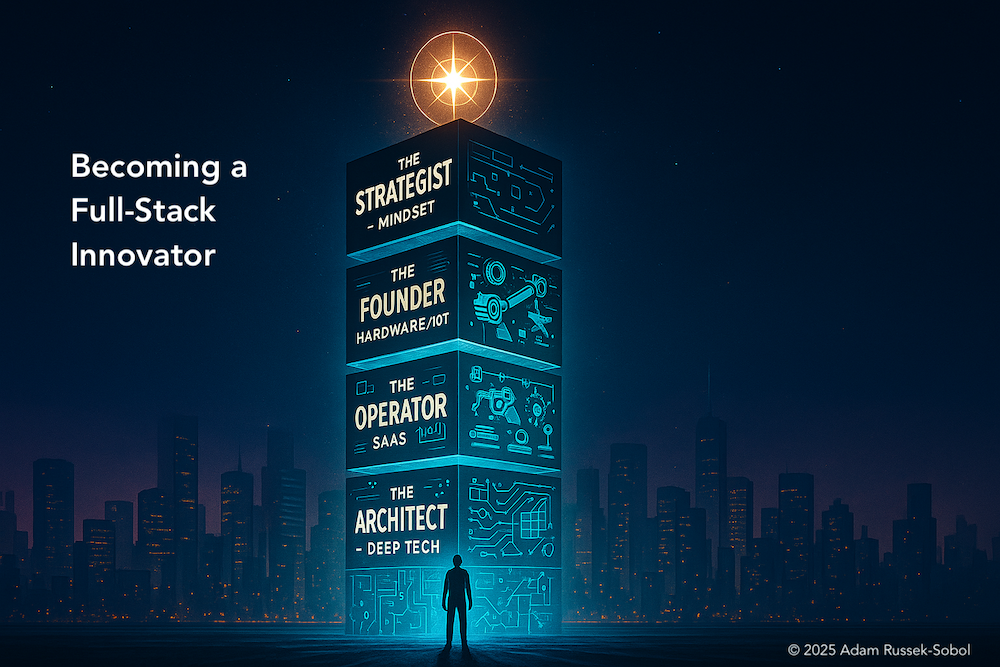
- Are You a Founder, or a Full-Stack Innovator?
- Part 1: The Architect – Beyond the Idea: Why Your IP is the True Foundation of Your Hard-Tech Venture
- Part 2: The Founder – The Atoms and the Bits: Lessons from the Trenches of a Hardware + Software Startup
- Part 3: The Operator – What Building a SaaS Company Taught Me After Surviving Hardware
- Part 4: The Strategist – You’re a Founder, Not Just a CEO: Why Your Philosophy is Your Most Valuable Asset
We’ve explored the first three pillars of the Full-Stack Innovator: the Architect who builds the technical moat, the Founder who survives the trenches of hardware, and the Operator who scales with the playbook of modern SaaS.
But there’s one final, crucial layer that separates a founder who builds a successful product from a leader who builds an enduring company. It’s the Strategist.
In the day-to-day chaos of running a startup, it’s easy to get lost in the tactics. You’re a CEO, and your job is to execute. What’s our CAC? Are we hitting our sprint goals? Did you answer that investor’s email? We become so focused on the “what” that we lose sight of the “why.”
The Strategist’s role is to define and defend the “why.” It’s about building an operating system for your business based on a clear and coherent set of first principles.
Thinking in Public: Your Philosophy is Your Platform
For me, the laboratory for this has been my blog, “Maybe I’m Crazy,” and the community I’ve built at Founder’s Therapy. It’s a space to “think in public”—to articulate a belief, pressure-test it against reality, and refine it with the collective wisdom of others. It’s how you turn gut feelings into a repeatable playbook.
This isn’t an academic exercise; it’s a critical business function. When your principles are clear, your decisions become faster and more consistent. Here are a couple of principles from my own journey that have become core to my work:
1. Find Your Opportunity in the “Grey.”
The tech world is obsessed with the glamorous. But I’ve learned that the most durable, profitable opportunities are often in “grey companies“—those operating in unglamorous but essential sectors. Dementia care (Careband) and classroom observation software (Education Walkthrough) aren’t trendy, but they solve deep, specific problems for well-defined customers. These “grey” niches have less competition, higher customer loyalty, and a clearer path to profitability because you’re not just another startup chasing hype.
2. Innovate Responsibly.
As a technologist, it’s easy to get caught up in the potential of new tools like AI. But a Strategist thinks about the second- and third-order consequences. My writing expresses a healthy skepticism about AI’s current limitations—its potential to create misinformation and its training on flawed data. This doesn’t mean I’m anti-AI; it means I believe in innovating responsibly. In high-stakes fields like HealthTech and EdTech, trust and accuracy are non-negotiable. A thoughtful, critical perspective isn’t a barrier to innovation; it’s a prerequisite for building something that lasts.
The Theory is the Practice
Ultimately, this is the final evolution of the founder’s journey. Your company, your products, and your leadership style all become physical manifestations of your core beliefs.
- The Architect builds what is possible.
- The Founder survives how to build it.
- The Operator scales the machine.
- The Strategist provides the enduring why.
This is the work that moves you from being the person who does everything to the person who provides the clarity that empowers everyone else to do their best work. That is the true mark of a Full-Stack Innovator.
Thank you for following this series on Becoming a Full-Stack Innovator.
Ready to build your own playbook? Download my free guide, The Full-Stack Innovator’s Playbook, to get the complete framework for your hard-tech venture.
Want to talk strategy? If my approach resonates with you, let’s connect. You can schedule an introductory call here