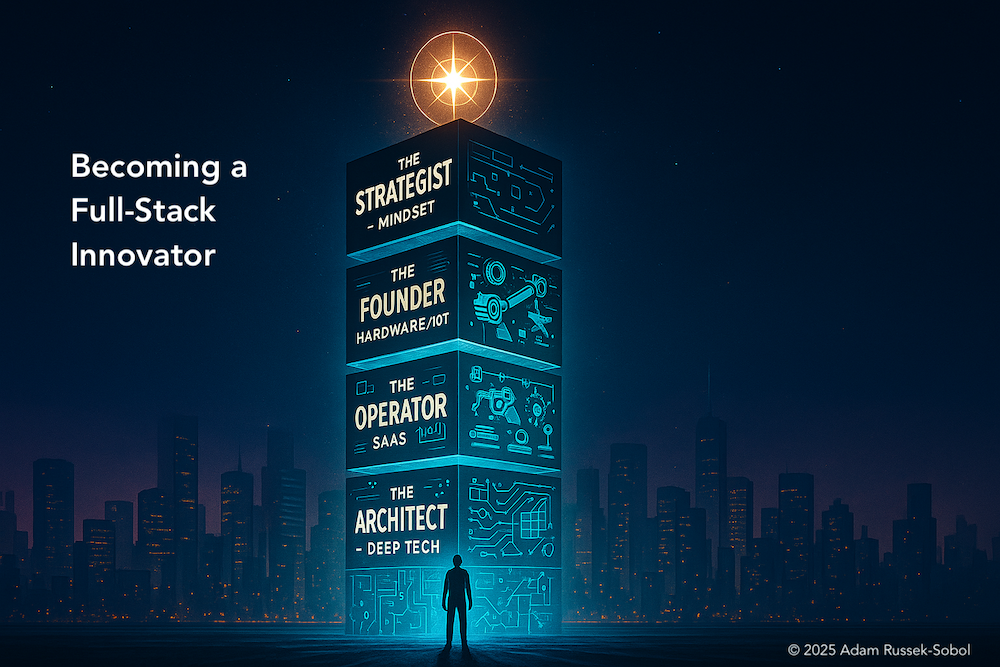
- Are You a Founder, or a Full-Stack Innovator?
- Part 1: The Architect – Beyond the Idea: Why Your IP is the True Foundation of Your Hard-Tech Venture
- Part 2: The Founder – The Atoms and the Bits: Lessons from the Trenches of a Hardware + Software Startup
- Part 3: The Operator – What Building a SaaS Company Taught Me After Surviving Hardware
- Part 4: The Strategist – You’re a Founder, Not Just a CEO: Why Your Philosophy is Your Most Valuable Asset
In the first two parts of this series, we covered the Architect who designs the defensible moat and the Founder who survives the trenches of building a hardware business. But to be a truly versatile leader in today’s tech ecosystem, you have to master the dominant business model of our time: Software-as-a-Service (SaaS).
After the intense, high-stakes world of CareBand—with its regulated markets, international supply chains, and long enterprise sales cycles—my next venture, Education Walkthrough, was a deliberate strategic choice. It was a conscious effort to dive deep into the world of pure software and master the playbook of the Operator.
The goal was to prove fluency in a completely different operational arena: moving from the top-down, high-touch sales motion of hardware to the bottoms-up, low-friction world of product-led growth (PLG).
Putting Theory into Practice: The 90% Margin Paradox
One of the core principles I write about on my blog is the “90% Margin Paradox.” In short, the near-zero marginal cost of software shouldn’t be an excuse for high prices; it should be leveraged to enable lower prices, which reduces friction and optimizes for mass-market adoption.
Education Walkthrough was the perfect laboratory to put this theory into practice. We built the entire business on a classic freemium model. The free version provided immediate, tangible value to individual teachers and school administrators, allowing them to conduct up to five classroom walkthroughs a month.
This wasn’t just a trial; it was our primary marketing engine. It solved a real problem so effectively that it attracted thousands of users organically through word-of-mouth. The affordable premium tier then became an easy, logical upgrade for entire schools and districts that were already seeing the value. By prioritizing adoption over short-term revenue, we bootstrapped the company to $200k in annual recurring revenue before raising a single dollar of outside capital.
Mastering Two Different Machines
The contrast with CareBand couldn’t be starker. One was a world of pilot programs and building deep trust with a few large enterprise clients. The other was a world of low-friction onboarding, data-driven feature development, and scaling a high-margin business to hundreds of customers across the globe with a team of three.
Mastering both of these playbooks—the high-touch enterprise sale and the low-touch PLG motion—is what gives a founder true operational range. It’s the ability to diagnose a product and market and apply the right commercial engine to make it succeed.
That is the work of the Operator.
Enjoyed this post? *This is the third in a four-part series on Becoming a Full-Stack Innovator. Next week, we’ll conclude with the final pillar: The Strategist,