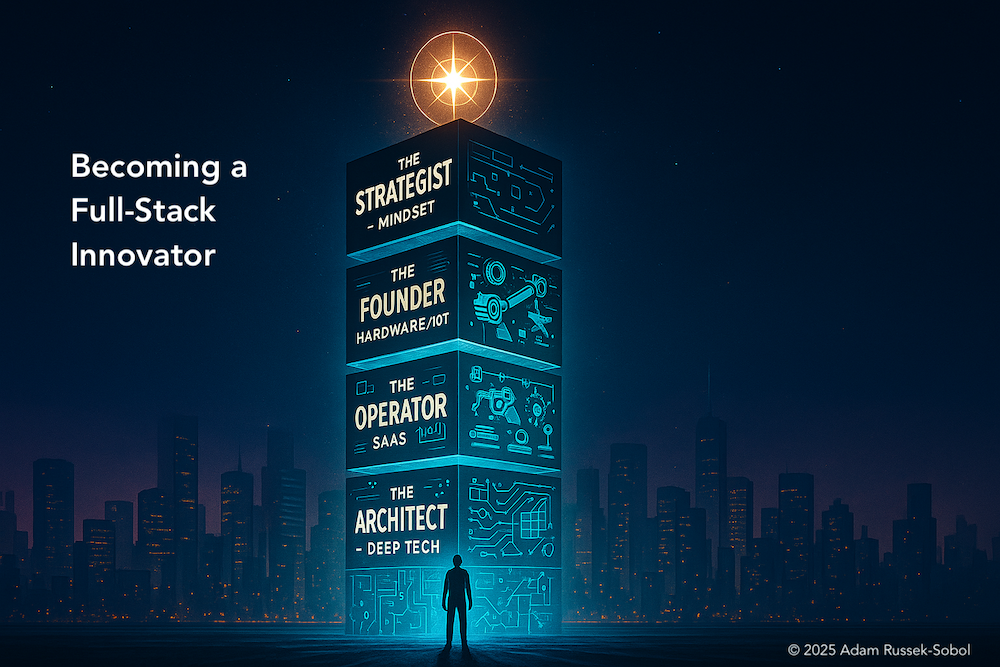
- Are You a Founder, or a Full-Stack Innovator?
- Part 1: The Architect – Beyond the Idea: Why Your IP is the True Foundation of Your Hard-Tech Venture
- Part 2: The Founder – The Atoms and the Bits: Lessons from the Trenches of a Hardware + Software Startup
- Part 3: The Operator – What Building a SaaS Company Taught Me After Surviving Hardware
- Part 4: The Strategist – You’re a Founder, Not Just a CEO: Why Your Philosophy is Your Most Valuable Asset
It all started with a conversation. In 2014, I was talking with my father, a geriatrician, about the emerging world of wearable technology. We weren’t talking about counting steps; we were talking about a profound human challenge: how could we use this new technology to help people with dementia live more safely and independently?
That conversation sparked the idea for CareBand. But it also taught me the most important lesson for any founder building a business in the physical world: your most valuable asset isn’t your idea. It’s the architecture you design to make that idea a reality.
In the rush to build an MVP and get to market, many hard-tech founders treat intellectual property as an afterthought—a legal box to check when they have the time and money. This is a critical mistake. For those of us building complex products, your IP isn’t just a defensive shield; it’s the strategic roadmap for your entire company. It’s where you must slow down to speed up.
From a Human Problem to a Technical Moat
The initial question for CareBand was simple: how can we track a person who might wander? But the first answers were full of holes. GPS was too power-hungry. Wi-Fi had no range. Cellular was expensive and drained batteries in hours.
This is where the work of an Architect begins. Instead of patching a broken model, we had to go back to first principles. Our strategic journey, which is now chronicled in a portfolio of over 20 patents, followed a clear, logical progression.
1. Solving for Power & Range: The LPWAN Foundation
The first and most fundamental barrier was physics. For a wearable for older adults to be useful, it needs to be reliable and last for days, not hours. We made a foundational architectural choice to build our solutions around Low Power Wide Area Networks (LPWAN). This wasn’t just an incremental improvement; it was a decision to prioritize what the user actually needed: reliability and longevity. By solving for power and range first, we created the stable foundation upon which everything else could be built.
2. Solving for Data & Intelligence: The Edge AI Evolution
Once we could reliably connect the device, the next challenge emerged. Transmitting a constant stream of raw sensor data over a low-bandwidth network is incredibly inefficient. It costs money, drains the battery, and raises privacy concerns.
The solution was to stop shipping raw data and start shipping insights. Our most advanced patent details an edge computing system that processes sensor data locally using a dedicated machine-learning processor on the device itself. The device doesn’t just report that a person has fallen; it knows they’ve fallen and transmits only that critical alert. This leap from data collection to on-device intelligence was the final piece of the architectural puzzle, making the system scalable, efficient, and private.
Your Patent is Your Playbook
Looking back, that patent portfolio tells a story. It’s a step-by-step chronicle of identifying a core human problem, anticipating the technical barriers, and systematically inventing the solutions.
For hard-tech founders, this is the real work. It’s the deep, strategic thinking that happens long before you worry about marketing funnels or your LTV:CAC ratio. Your IP portfolio is your defensible moat, but more importantly, it’s your strategic playbook. It proves to investors, partners, and your team that you haven’t just built a product—you’ve built a lasting technological advantage.
That is the work of an Architect.
Enjoyed this post? This is the first in a four-part series on Becoming a Full-Stack Innovator. Next, we’ll explore the second pillar: The Founder, and the lessons learned in the trenches of building a hardware + software company.
Want the full framework now? Download my free guide