
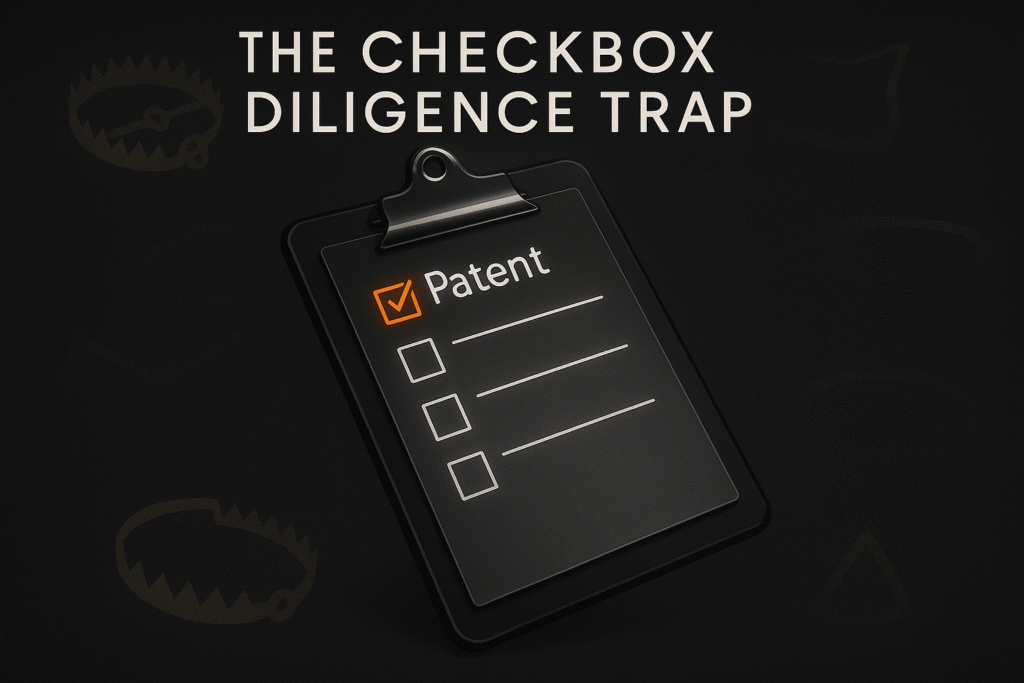
As a founder who has pitched to dozens of VCs, I’ve noticed a recurring pattern that still surprises me: most investors treat a company’s intellectual property (IP) portfolio as nothing more than a checkbox. In countless meetings, I’ve been asked, “Do you have a patent?”—and once I said “yes,” the conversation immediately moved on.
No follow-up. No questions about the scope. No digging into the strength of claims. Just a quick mental tick mark in the “risk mitigated” column.
At first, I thought this was just a quirk of a few investors I’d met. But over time, I realized it was systemic. The diligence around technology defensibility—the very backbone of many startups’ long-term moat—is often paper-thin. And this isn’t just a quirk; it’s a blind spot that creates enormous hidden risks for limited partners (LPs) and can derail otherwise promising investments.
The “Checkbox Diligence” Phenomenon
When I think back to my fundraising experiences, one moment stands out. I was walking an investor through a product we had been building for years—a truly novel technology that we’d worked hard to protect through a carefully structured patent strategy.
The investor nodded, smiled, and asked the usual questions about market size, customer pipeline, and growth plans. Then came the IP question:
“Do you have a patent?”
“Yes,” I replied.
“Great.”
And that was it.
No one asked:
- What’s in the claims?
- How broad is the coverage?
- Have you performed a freedom-to-operate (FTO) analysis to ensure you’re not infringing on anyone else?
- Do you have a strategy for trade secrets in addition to patents?
It became clear that, for most investors, the mere existence of a patent was enough to move the diligence process forward.
Why This Blind Spot Exists
To be fair, I don’t blame investors. Their expertise lies in other areas:
- Markets – understanding TAM, customer adoption, and growth potential.
- Teams – backing the right founders who can execute under pressure.
- Metrics – interpreting early signals from revenue, retention, and growth rates.
Very few investors are trained in the technical nuances of patent law. And why would they be? Patent claims are dense, the legal landscape is constantly shifting, and meaningful IP analysis requires specialized training and weeks of review.
On top of that, VCs are incentivized for speed. Deals are competitive, timelines are compressed, and deep technical diligence feels like friction. So, the IP portfolio gets reduced to a checkbox.
The Hidden Risks of a Weak Portfolio
But here’s the problem: a weak IP portfolio is not just a missed opportunity—it’s a landmine.
I’ve seen it firsthand and heard horror stories from other founders:
- The Litigation Trap: A company raises millions on the back of its “unique” technology, only to face a costly lawsuit when a competitor sues for infringement. The patent they were relying on was too narrow to defend them.
- The Hollow Patent: A startup proudly touts its patent, but the claims only cover a trivial feature. Competitors can easily design around it, leaving the company with no real moat.
- The Acquisition Killer: An acquirer performs deep IP diligence post-term sheet, discovers major freedom-to-operate issues, and walks away—torpedoing the exit and crushing investor returns.
Each of these outcomes is avoidable. But only if the right diligence happens upfront.
Beyond the Checkbox: Smarter Questions Investors Should Ask
Instead of stopping at “Do you have a patent?”, investors should be asking:
- What is your freedom to operate (FTO)?
Have you mapped the existing patent landscape to confirm you’re not stepping on someone else’s IP? - How strong are your claims?
Do your patents actually block competitors, or are they easy to design around? - What is your trade secret policy?
Not everything belongs in a patent. How do you safeguard proprietary processes, algorithms, or data sets? - What’s your forward-looking IP strategy?
Are you just filing for defensive purposes, or are you building an expanding moat that aligns with your growth plan?
These questions don’t just surface risks—they uncover how strategically a founder is thinking about defensibility.
The Role of a Specialist Advisor
This is where an independent IP strategist comes in. In as little as two to three weeks, a specialist can:
- Review the scope and strength of existing patents.
- Identify freedom-to-operate risks.
- Evaluate trade secret practices.
- Map the competitive landscape.
The result is a clear, objective report that tells investors whether the technology moat is real—or just a mirage. It’s the kind of certainty that standard diligence processes miss, and it can save millions down the line.
Moving Beyond the Checkbox
We’re entering a world of increasing technological complexity. AI, biotech, robotics, climate tech—these aren’t industries where a simple “yes” or “no” on patents is enough. The investors who will outperform in the next decade are the ones who can accurately assess a company’s IP defensibility and technological moat.
Checking the patent box might feel efficient in the moment. But real diligence requires going deeper. The risks are too high, and the upside of getting it right is too great.
It’s time to move beyond the checkbox.